


There’s something exciting happening in Puerto Rico. Perhaps you’ve heard. Maybe a friend of a friend just returned from “PR.” Or you vaguely recall a viral image of LeBron James dancing in a bucket hat at a house party this summer. Or, maybe you hosted a viewing party in your living room, along with 340,000 other attendees, to stream Bad Bunny’s No Me Quiero Ir De Aquí: Una Más concert on Amazon together.
This summer, the global superstar rapper and singer, Bad Bunny (Benito Antonio Martínez Ocasio), staged a “residency” of 31 concerts in his hometown of San Juan, Puerto Rico. And he is strategically and brilliantly using gathering as a tool to shift culture on a global stage.
When done with care, gatherings don’t just mirror culture, they shape it. This summer, Bad Bunny is showing us how.
10 ways Bad Bunny is using gathering to shift culture (and what the rest of us can learn from him)
1. Bad Bunny makes purpose his bouncer. The purpose of his residency, stated clearly, is to be a love letter to Puerto Rico. And he used this specific, disputable purpose to be the North Star to inform every decision of the tour. It informed ticketing: the first nine concerts were exclusively reserved for Puerto Rican residents. (To get in, you had to show proof of residence). The purpose informed the staging of the entire concert: What if we made an 18,000-person arena feel like the intimate, casual party de marquesina (or a local balcony party) known to every puertorriqueño? The purpose informed who was invited and what they were asked to sing: What if we asked Marc Anthony not to sing one of his hits, but instead Puerto Rico’s unofficial national anthem, Preciosa, to close out the concert together? And, most obviously, the purpose informed the location of the concert: What if instead of singing about Puerto Rico in other countries, what if we brought the world to Puerto Rico?
2. Like good gatherers, Bad Bunny is a great namer. I was struck by the name of the Puerto Rican residency at the Colesio de Puerto Rico: No Me Quiero Ir de Aquí, or “I don’t want to leave here.” It’s a lyric taken from his song El Apagón on another album Un Verano Sin Ti. It’s also the content of his love letter. And, in giving the tour this name, every time anyone refers to the concert, they utter the words “I don’t want to leave here.”
3. Bad Bunny has the cultural confidence to elevate the familiar over the flashy. When celebrities are invited “backstage” to his concert, instead of being ushered into a red velveted VIP section on the floor, they enter a house party, in a house, on the stage. “The Casita,” is a small house in the traditional Puerto Rican architectural style that serves as a party and gathering space. The house itself was originally created by production designer Mayna Magruder and is modeled after a real house in Humacao. They’ve filled with details locals would recognize immediately: rattan furniture, ceramics from specific local artists, and walls that echo grandparents’ houses across the island. They’ve turned the kitchen into a bar, and guests hang out on the balcony, in the same way puertoriceños do in their own homes with neighbors and friends.
4. Through his use of “the Casita,” he honors and awes. Inside the Casita, there are two rules: no pictures inside the Casita and have fun. By banning photos, Bad Bunny creates the possibility for guests to actually just hang out together. But, they’re also on display (which they know) to the entire arena. What he’s created is complex to do well: a house party that celebrities are knocking down the door to attend, even though it’s in front of 18,000 people. But it works.
5. He uses his opening to create a world (and a thesis). Every gathering is a temporary world, and Bad Bunny begins each night by declaring one. A woman walks onstage searching for her camera of memories. A man follows, looking for his bomba drum. They ask the crowd if they’ve seen them. “No!” the audience shouts back — the first call and response of the night. When the drum is finally found and struck, dancers in traditional jíbaro dress flood the stage. And only then, Bad Bunny appears. Behind him, the screen blazes: “Puerto Rico es un territorio no incorporado de Estados Unidos pero tiene su bandera, su cultura y su propia identidad” – “Puerto Rico is a non-incorporated territory of the United States but it has its flag, its culture, and its own identity.” In five minutes, he offers a thesis and builds a world.
6. Bad Bunny doesn’t hoard his cultural capital, he spends it. If you want to see me play, come hang out in Puerto Rico. If you like my music, come jam with us on the island. If you want to experience my concerts, it’s going to be inconvenient for you if you don’t live in Puerto Rico. Bad Bunny could have filled any stadium in the U.S., but he chose San Juan. It’s not just strategy, its stewardship. For many concertgoers, it’s become somewhat of a pilgrimage (Check out this sing-along on a flight landing in Puerto Rico on August 30th). In November, he will start a world tour, though is skipping the US.
7. Bad Bunny knows when and how to exclude and when and how to include. The first nine shows of the residency were reserved for Puerto Rican residents only. He’s not trying to be everything to everyone. Before the world comes rushing in, this love letter is for you first, my neighbors. For the first 30 concerts, they protect the intimacy of the live, in-person gathering. And only once that intimacy and localization has been securely accomplished, do they allow one final show to be livestreamed for the world to see. (That September 20th concert became Amazon’s most-watched single-artist performance ever.) As a host, Bad Bunny understands that exclusion and inclusion aren’t opposites; they’re tools that help fulfill a gathering’s purpose.
8. He understands the economics of gathering. We’ve seen the “Taylor bump” and the “Beyoncé bump,” when a single night of music spikes a city’s local economy through hotel and restaurant reservations. By rooting the residency in Puerto Rico, he has poured hundreds of millions into the island at a critical moment. And he didn’t stop there. The final show marked the 8th anniversary of Hurricane Maria. As part of the Amazon streaming deal, he got commitments to education, agriculture, and tech investment on the island. He knows that a concert like this doesn’t just sustain spirits, but livelihoods.
9. He gives guests meaningful roles, and connects each concert to the next. In every show, there is a moment in a song where one beloved guest is invited to shout out, “Acho, PR es otra cosa!” at the start of VOY A LLeVARTE PA PR. He’s found a simple participatory way to honor a guest near and dear to him in attendance that evening, while also invisibly connecting them to the concerts on previous nights.
10. Bad Bunny is hosting a gathering he actually wants to attend. He wants to play in a home. He wants the Casita. He wants to close with “Preciosa.” (And is probably not shocked at how many people are crying when they hear this beloved song from their childhood being sung by the entire crowd together.) And when a host gathers around what gets them excited, people can’t help but want to join. (It’s exactly what we spoke about in this GROUP HELP Session.)
I am thrilled but not surprised that he’s just been announced to be the headliner for the 2026 Super Bowl Halftime Show. Benito Antonio Martínez Ocasio will be the first artist to take that stage with a catalog performed entirely in Spanish. And I, for one, will definitely be tuning in.
As always,
Priya
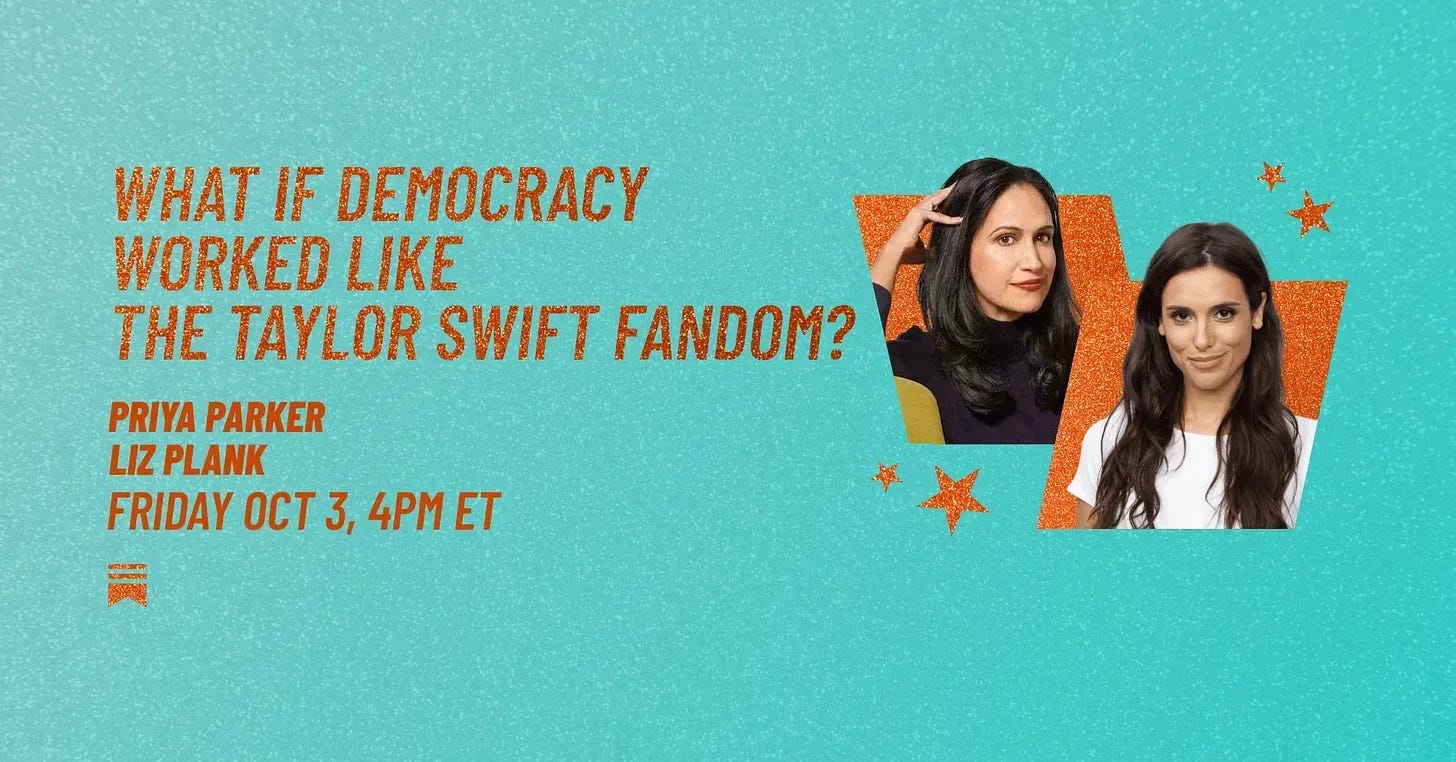
TODAY, Friday, October 3 at 4 pm ET, I’ll be going live on Substack with Liz Plank to talk about Taylor Swift’s brand new album The Life of a Showgirl. During our Live, What If Democracy Worked Like the Taylor Swift Fandom?, we’ll dive into the surprising ways fandom can mirror — and sometimes outshine — civic participation.
This live conversation is part of a weekend-long series of Taylor Swift album events happening on Substack, where creators from across culture, music, sports, and beyond are coming together to share their takes on the biggest cultural moment of the year.
You’ll get to tune in live, join the chat, and even send in your own questions and reactions. This event is open to ALL subscribers.
Wow. This is amazing.
How does the “placita” start setting the tone?
-and wow the facts flashing! Perfect example
-the perrear moment. Wow. He’s not scared of his audience, he’s inviting them in and creating collective presence
-and thanks for the spelling. Eep. Fixing.
Great noticing thank you for sharing!!
Been thinking about this too! Some other observations:
-outside the venue there is a “placita” that starts setting the tone.
-while you’re waiting for the concert to start inside there are facts about puerto rico flashing in and out of the main screen and jíbara music playing.
-the food in consignments also got revamped to showcase puertorrican staples.
-although one of his songs is “I should have taken more pictures” he has multiple calls of the audience to be more present, and drop their phones for a second. Then invites them to “perrear” - the concert has a shift in tone in that moment that is liberating
-each guests receives a lanyard that doubles as a stage light, when he sings it gets activated, making the entire stadium feel connected
Small correction: it’s puertorriqueño :)